
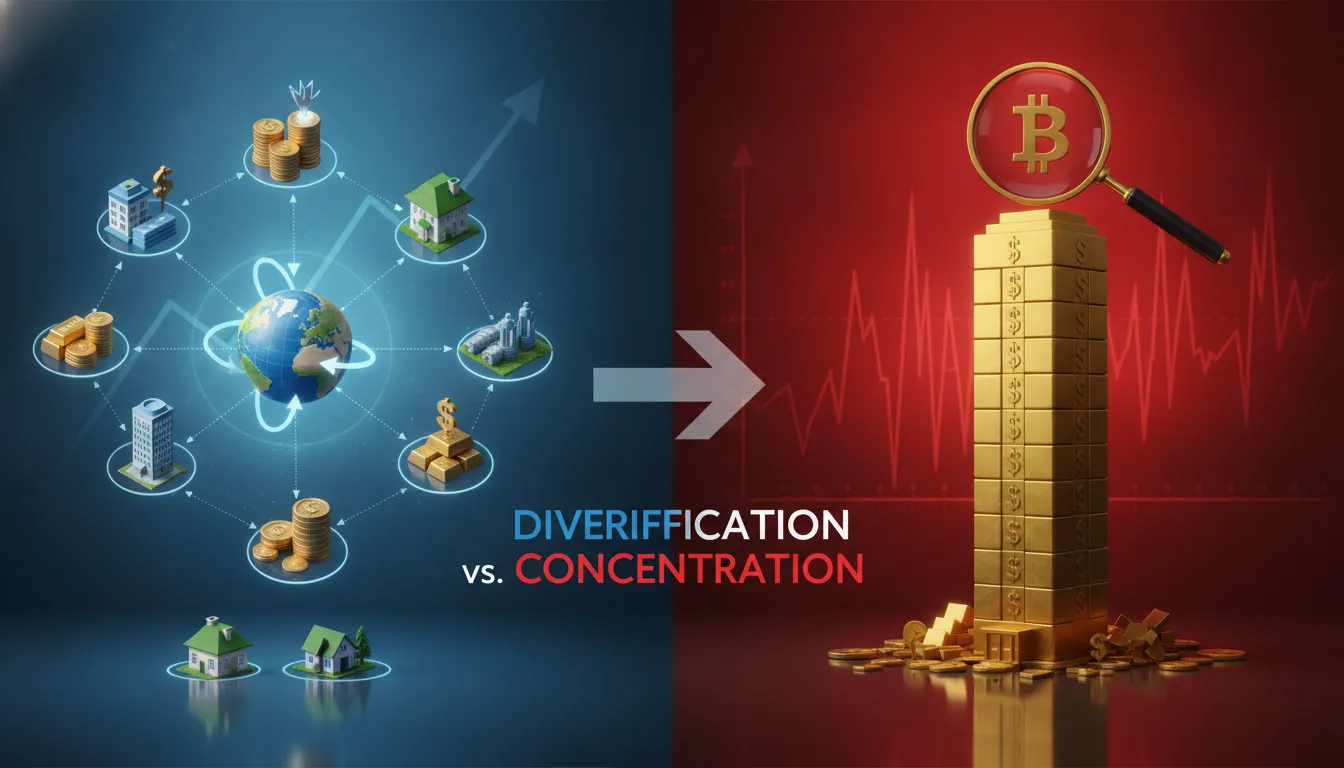
Diversify or Concentrate? Choosing the Investment Approach That Truly Fits Your Goals
One of the oldest debates in the world of investing revolves around a deceptively simple question: should you spread your money across many different assets, or focus it on a select few high-conviction opportunities? On one side stand the champions of diversification, who preach the wisdom of not putting all your eggs in one basket. On the other stand the concentrators, who point to legendary investors like Warren Buffett and argue that real wealth is built by betting big on what you understand deeply.
The truth, as with most things in finance, is more nuanced than either camp admits. The right approach depends on your goals, your temperament, your knowledge, and your stage of life. In this article, we’ll explore both strategies in depth, examine their strengths and weaknesses, and help you decide which philosophy truly aligns with your financial ambitions.
Understanding Diversification
Diversification is the practice of spreading your investments across a wide range of assets, sectors, and geographies to reduce risk. The logic is straightforward: when your money is distributed among many holdings, the poor performance of any single investment has a limited impact on your overall portfolio. If one company struggles, others may thrive and offset the loss.
Nobel laureate Harry Markowitz formalized this idea in his Modern Portfolio Theory, which demonstrated mathematically that a well-diversified portfolio can achieve better risk-adjusted returns than a concentrated one. According to Investopedia, diversification is often described as “the only free lunch in investing” because it allows you to reduce risk without necessarily sacrificing returns.
Modern tools have made diversification easier than ever. Index funds and exchange-traded funds (ETFs) allow investors to own hundreds or even thousands of companies with a single purchase. If you’re just getting started, understanding these building blocks is essential — our guide on Your First Investment: A Beginner’s Guide to Making Money Work for You is a great place to begin.
The Case for Concentration
Concentration takes the opposite view. Instead of spreading your bets thinly, you commit significant capital to a small number of carefully selected investments. The reasoning is that truly great opportunities are rare, and when you find one, you should invest heavily rather than diluting your gains across mediocre options.
Warren Buffett, perhaps the most famous proponent of this philosophy, once remarked that “diversification is protection against ignorance. It makes little sense if you know what you are doing.” His argument is that deep knowledge of a handful of businesses can produce far greater returns than a shallow understanding of many.
Concentration has undeniable appeal. When you concentrate on your best ideas, a single winning investment can dramatically transform your wealth. Many of history’s greatest fortunes were built not through diversification, but through significant ownership stakes in a small number of exceptional companies.
The Trade-Off Between Risk and Reward
At its core, the diversify-or-concentrate debate is really a debate about the relationship between risk and reward. Concentration amplifies both. When your concentrated bets pay off, the returns can be spectacular. But when they fail, the losses can be devastating — and potentially irreversible.
Diversification, by contrast, smooths out the ride. You’re unlikely to double your money overnight with a broadly diversified portfolio, but you’re also far less likely to suffer catastrophic losses that derail your financial future. For most people, this stability is worth more than the possibility of outsized gains.
Consider the psychological dimension as well. A concentrated portfolio can swing wildly in value, testing your emotional discipline. Many investors who thought they could handle concentration have panicked and sold at the worst possible moment. Diversification helps you stay the course, which is often the single most important factor in long-term success.
How Your Goals Should Shape Your Decision
There is no universally correct answer to the diversify-or-concentrate question. The right choice depends heavily on what you’re trying to achieve. Ask yourself the following questions:
What is your time horizon? If you’re investing for a goal that’s decades away — such as retirement — you can afford to weather volatility, and the power of compounding will work in your favor. Understanding this dynamic is crucial, as we explain in The Compounding Effect: Why Time Is Your Greatest Ally in Building Lasting Wealth.
How much do you know? Concentration requires genuine expertise. If you can analyze financial statements, understand competitive dynamics, and value businesses accurately, you may be positioned to concentrate wisely. If not, diversification is the safer path.
What is your risk tolerance? Be honest about how you’d react to seeing your portfolio drop 40% in a matter of weeks. If that thought keeps you up at night, concentration is probably not for you.
A Balanced Middle Ground
Fortunately, you don’t have to choose one extreme or the other. Many successful investors adopt a hybrid approach known as the “core and satellite” strategy. The core of the portfolio consists of broadly diversified index funds that provide stability and steady growth. Around this core, a smaller portion is allocated to concentrated, high-conviction bets that offer the potential for outsized returns.
This approach lets you capture the benefits of both philosophies. Your core protects you from catastrophic loss, while your satellites give you the opportunity to outperform. As your knowledge and confidence grow, you can adjust the balance to suit your evolving comfort level. Developing that confidence is a journey — one we describe in From Confusion to Confidence: How the Right Investment Course Rewires the Way You Think About Money.
Diversifying Beyond the Stock Market
True diversification isn’t limited to owning different stocks. It also means spreading your wealth across asset classes such as bonds, real estate, and commodities. Real estate, in particular, offers powerful diversification benefits because its returns often move independently of the stock market. If you’re interested in building wealth through property, our article Brick by Brick: Building a Real Estate Portfolio That Outlasts Market Cycles offers valuable insights.
Technology has also lowered the barriers to diversification. With modern investing apps, you can build a diversified portfolio in minutes, often with fractional shares that let you own pieces of expensive stocks. Learn more about these tools in One Tap to Invest: How Modern Platforms Put the Market in Your Pocket.
Conclusion

The choice between diversification and concentration is not about finding the “correct” answer — it’s about finding the approach that fits you. Diversification offers safety, stability, and peace of mind, making it ideal for most investors, especially those still building their knowledge. Concentration offers the potential for extraordinary returns, but demands deep expertise, emotional discipline, and a tolerance for risk that few possess.
For the vast majority of people, a diversified core supplemented by a few carefully chosen high-conviction positions represents the best of both worlds. Whatever path you choose, let it be guided by your goals, your knowledge, and an honest assessment of your own temperament. In investing, self-awareness is just as valuable as market awareness — and it may ultimately be the truest key to building lasting wealth.
